SPEAK WITH A SPECIALIST
800-462-0071

I WANT TO

1930 Wheat Penny Value

Learn more about the 1930s wheat penny value, history, and design elements with this guide from American Hartford Gold.

The 1930 Wheat Penny captures a major moment in American history and numismatics, reflecting both artistic ideals and the harsh economic realities of the early

Heading for Another Great Depression?

Heading for Another Great Depression?

Markets are showing alarming similarities to the early days of the Great Depression.

Investor confidence is shaken as recession risks and policy instability grow.

Americans are protecting their portfolios from uncertainty with the stability of physical gold.

Stocks Continue to Slide

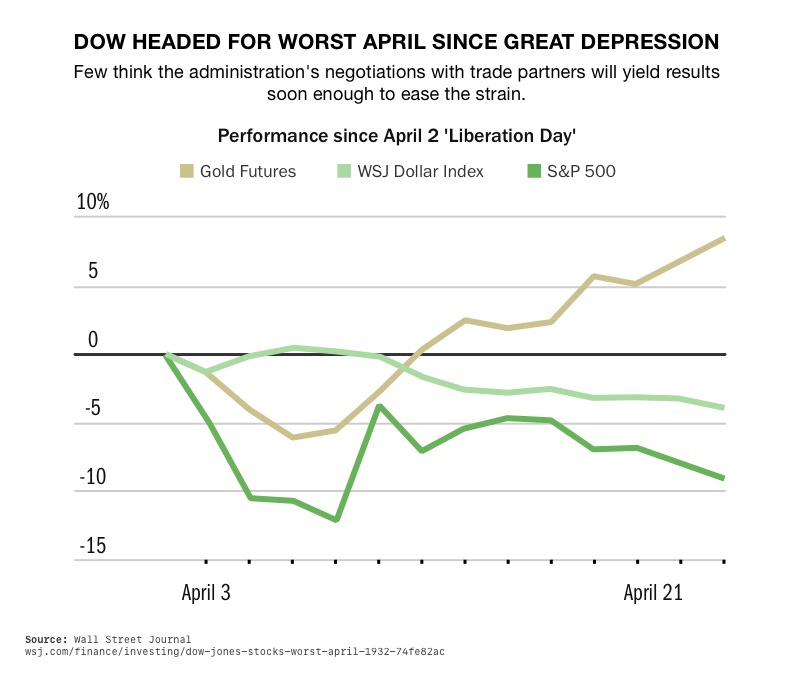
Investors and analysts are drawing eerie parallels between today’s market and the onset of the Great Depression. The Dow Jones Industrial Average recently lost nearly 1,000 points. Prompting the Wall Street Journal to note that the market was “headed for its worst April performance since 1932.” For historical context, that was during the darkest days of the Great Depression, a time few thought they’d see echoed again.1

But now, many fear that history may be repeating itself.
Blog Chart

2

S&P 500 Decline Raises Alarm

The S&P 500 has dropped 9% since former President Trump announced his reciprocal tariff policy. It’s logged the worst performance since Inauguration Day for any president since 1928. Meanwhile, the dollar has sunk to its lowest level since March 2022. And the yield on the 10-year Treasury note has risen. Both mark a shift away from traditional safe havens.3

This instability has left investors with few safe spots to turn to. Uncertainty reigns, and, as one analyst put it, “no one wants to invest because of instability and the unknowable future.”

IMF Recession Warning and Fed Drama

That fear is backed by data. According to the International Monetary Fund (IMF), the U.S. economy faces rising headwinds. The IMF warned that tariffs would slow global growth and raised the odds of a U.S. recession from 25% to 40%. Unsettling policy moves haven’t helped. Trump’s threats to fire Fed Chair Jerome Powell sent the markets reeling, weakening the dollar even further. Analysts warn that removing Powell could trigger an even more severe drop.

Executives Lose Confidence

Executives aren’t optimistic either. Many corporate leaders doubt that Trump’s trade negotiations will lead to meaningful outcomes. During this earnings season, usually a time when stocks climb, the tone has shifted sharply. Bank of America reported that the ratio of positive to negative comments on macroeconomic conditions has dropped well below average. It is on track for the worst proportion since 2009.

Some companies are even withdrawing full-year guidance altogether. Kimberly-Clark lowered its profit expectations. Automakers have slashed their earnings outlooks the most. As uncertainty rises, Bank of America warns of “a potential information vacuum” as companies avoid making predictions. Much like they did during the early days of the COVID-19 pandemic.

Volatility and Fear Grip Investors

Volatility remains high. The VIX “fear gauge” is elevated. It is reflecting widespread investor concern about the ongoing trade war and expectations of continued turbulence ahead. Bearish sentiment is rising among individual investors. Expectations that stock prices will fall has hovered above 50% for more than eight consecutive weeks. According to the American Association of Individual Investors, that’s the longest-lasting bear majority on record since tracking began in 1987.

Even though the market managed a wild rebound on Tuesday, climbing nearly 700 points, investors remain cautious. A portfolio manager at Argent Capital Management said, “Lots of uncertainty, not lots of answers, kind of a frustrating environment today for investors. The one feeling that I feel like I can identify is the longer we remain in this limbo, the worse it gets for the economy.”4

Blog Image

Gold Surges as the New Safe Haven

In the face of all this, one asset is bucking the trend: gold.

Gold has soared above $3,500 an ounce for the first time ever in a dramatic “flight to safety.” It continues a powerful rally that began at $2,623 an ounce at the start of the year. In just a matter of weeks, gold has smashed through multiple milestones, including the $3,000 mark. Now, analysts predict it could climb to $4,000 in the coming weeks — a staggering rise that reflects growing investor panic.5

Market Predictions

The reasons are clear. As inflation heats up, and growth slows, Wall Street forecasters like Stifel, UBS, and Bank of America are warning of a rising risk of stagflation. This toxic mix of high inflation and sluggish growth poses a unique challenge for the Federal Reserve. And investors know it.

Goldman Sachs has slashed its forecast for the S&P 500, not once, but twice, this year. The bank now expects the benchmark index to return -5% over the next three months and just 6% over the next 12 months, down from earlier targets of 0% and 16%. They don’t expect the index to return to its all-time high of 6,100 anytime soon.

Goldman’s strategists also downgraded expectations for corporate earnings. They now forecast S&P 500 earnings per share (EPS) growth of just 3% in 2025, down from 7%, and a similar drop in 2026. “Higher tariffs, weaker economic growth, and greater inflation than we previously assumed lead us to cut our S&P 500 EPS growth forecasts,” they said. In a recession, they estimate the S&P 500 could tumble to 4,600 — a 21% drop from current levels.6

Conclusion

This may be the beginning of a long decline in stock value. If the market continues along this trajectory, the economic pain could deepen. Gold has historically performed well in times of uncertainty. The flight to gold may just be getting started.

If you’re looking to protect your retirement savings, now may be the time to consider a Gold IRA. It offers a long-term safeguard against inflation, market volatility, and economic downturns. Call American Hartford Gold at 800-462-0071 to learn how to get started.

Notes:
1. https://newrepublic.com/post/194253/donald-trump-tariffs-economy-great-depression
2. https://encrypted-tbn0.gstatic.com/images?q=tbn:ANd9GcQ2Qj42xMNtXa3F-8t6ifjRRx3SpCBVUoF1oA&s
3. https://newrepublic.com/post/194253/donald-trump-tariffs-economy-great-depression
4. https://www.the-independent.com/news/world/americas/us-politics/dow-jones-trump-tariffs-stock-market-b2737510.html
5. https://www.share-talk.com/dow-jones-on-track-for-worst-april-since-1932-as-gold-eyes-4000/
6. https://www.businessinsider.com/stock-market-outlook-sp500-recession-tariffs-goldman-sachs-stock-correction-2025-3


“Worse Than a Recession”

Worse Than A Recession

  • Billionaire investor Ray Dalio warns the U.S. is on the brink of a major economic downturn
  • Rising debt, trade chaos, and global instability could trigger a crisis worse than a recession
  • Protect your portfolio from uncertainty by investing in physical gold through a Gold IRA

Dalio Warns of Economic Crisis

Ray Dalio, founder of Bridgewater Associates and the man who famously predicted the 2008 financial crisis, is sounding a new alarm. In recent comments, Dalio warned that the U.S. is approaching a recession, and potentially something far worse.

“Right now we are at a decision-making point and very close to a recession,” Dalio said. “And I’m worried about something worse than a recession if this isn’t handled well.”1

Dalio’s concerns stem from several growing threats to the global economy. Threats such as rising national debt, disruptive trade policies, and a breakdown of long-standing political and economic systems. These forces, he warns, could converge into a crisis that may rival or even surpass the financial upheavals of 2008 or 1971, when the U.S. abandoned the gold standard.

A Ticking Time Bomb

At the heart of Dalio’s warning is the soaring U.S. debt, which now exceeds $36 trillion. He described the debt burden as a “ticking time bomb”. Dalio pointed to a fundamental “supply-demand problem for debt”. In other words, there’s too much debt and not enough buyers.

AHG Blog Chart

2

Congress, he says, must reduce the federal deficit to 3% of GDP to restore fiscal balance. But even that may not be enough to avoid economic turmoil.

Dalio also drew stark comparisons to the 1930s. He noted “profound changes” in both domestic and global orders. He said that the world is moving away from a multilateral order led by America. And it’s moving towards a more fragmented, conflict-driven unilateral one.

Disruptive Tariffs and Trade Uncertainty

Trade tensions are a major contributor to the instability. Tariffs aim to balance trade and bring production back home. But they are causing chaos in the global economy. Dalio likened the tariff policies to “throwing rocks into the production system.”  He said that although the goals may be understandable, the implementation has been “very disruptive.”3

The White House has announced a 90-day pause on reciprocal tariffs.  But they are maintaining a 10% baseline tariff and a 145% tariff on Chinese goods. Though some exemptions have been made for consumer electronics. With no clear end in sight, these rapidly shifting policies have upended international trade.  There is “tremendous uncertainty” about which tariffs will remain in place and for how long.

The administration says that the main aim of these policies is to restructure global trade. But Dalio fears they might trigger instability on a scale not seen in decades. “How that’s handled could produce something that is much worse than a recession,” he warned.4

A Breakdown of Monetary and Political Order

Dalio’s warnings go beyond trade.  “The far bigger, far more important thing to keep in mind is that we are seeing a classic breakdown of the major monetary, political, and geopolitical orders,” he said. “This sort of breakdown occurs only about once in a lifetime, but they have happened many times in history when similar unsustainable conditions were in place.”5

In his worst-case scenario, a financial and trade crisis could even escalate into a military conflict. “It’s going to be very severe,” he concluded.

"Worse Than A Recession"

Why Dalio Holds Gold

In the face of these dire predictions, Dalio uses gold as a hedge against risk.

“History and logic demonstrate that when there are substantial risks that debts will either default or be repaid with depreciated currency, both the debt and the currency become unappealing,” Dalio explained. “Gold, conversely, is a non-debt-backed form of money.”

He adds that gold is “like cash, except unlike cash and bonds, which are devalued by the risks of default or inflation, gold is bolstered by the risks of debt defaults and inflation.”6

As governments around the world attempt to manage their debt by printing more money, currencies risk losing value. This process, known as inflating the debt away, often leads to hyperinflation, another reason gold can serve as a safe haven.

Dalio describes gold as “money that I can go from one place to another with. And it’s accepted around the world; it’s accepted by central banks. Today, by the way, gold is the third-largest reserve after dollars and euros… it’s an asset that is not somebody else’s liability.”7

He also notes that gold typically has a negative correlation to traditional portfolios. Meaning it tends to rise when other assets fall. “If you were to say, what if I was to overlay gold in my portfolio, it would reduce the risk and increase the expected return.”

Conclusion

If you’re concerned about inflation, debt, and the possibility of a crisis worse than a recession, you’re not alone. Ray Dalio has studied history and sees troubling patterns repeating. He’s protecting his assets with gold, and you can do the same.

At American Hartford Gold, we help individuals protect their savings with physical gold held in a Gold IRA. You can take control of your financial future—call us today at 800-462-0071 to learn how.

Notes:
1. https://www.cnbc.com/2025/04/13/billionaire-ray-dalio-im-worried-about-something-worse-than-a-recession.html
2. https://www.crfb.org/blogs/12-month-rolling-deficit-21-trillion-march-2025
3. https://www.reuters.com/markets/wealth/bridgewaters-ray-dalio-says-trump-trade-war-has-put-us-close-recession-2025-04-13/
4. https://www.cnbc.com/2025/04/13/billionaire-ray-dalio-im-worried-about-something-worse-than-a-recession.html
5. https://www.nbcnews.com/politics/politics-news/investor-predicted-2008-financial-crisis-says-worried-something-worse-rcna201040
6. https://markets.businessinsider.com/news/etf/billionaire-investor-ray-dalio-is-sticking-with-gold-as-a-hedge-against-inflation-history-and-logic-show-that-1033269427
7. https://markets.businessinsider.com/news/etf/billionaire-investor-ray-dalio-is-sticking-with-gold-as-a-hedge-against-inflation-history-and-logic-show-that-1033269427